Coffee Enzyme Trial Plan for Factory Teams
When an enzyme program is evaluated on the plant floor, the question is not whether the chemistry looks promising. The question is whether it improves the process under your operating constraints.
Enzymeforcoffee supports coffee processors with a structured trial plan for comparing control batches against enzyme-assisted processing in wet milling and extraction workflows. The goal is to give production, quality, and finance teams a clear decision file: what changed, what it was worth, and whether the process is stable enough to scale.
If you are looking for an enzyme supplier for coffee processing, this trial framework is built for practical validation: throughput, extraction yield, viscosity, filtration behavior, consistency, and downtime reduction.
Why run a structured enzyme trial?
Unstructured trials are hard to defend. If the coffee lot changes, residence time drifts, water temperature shifts, or the filter train is already loaded, the result becomes a debate instead of a decision.
A structured trial helps your team:
- Compare enzyme-assisted processing against a protected control batch
- Keep lot, water, temperature window, residence time, and operating records aligned
- Track metrics that matter to production and finance
- Identify whether the improvement is repeatable or only batch-specific
- Build internal confidence before line-wide adoption
- Reduce avoidable downtime during scale-up
Trial design: control batch versus enzyme-assisted batch
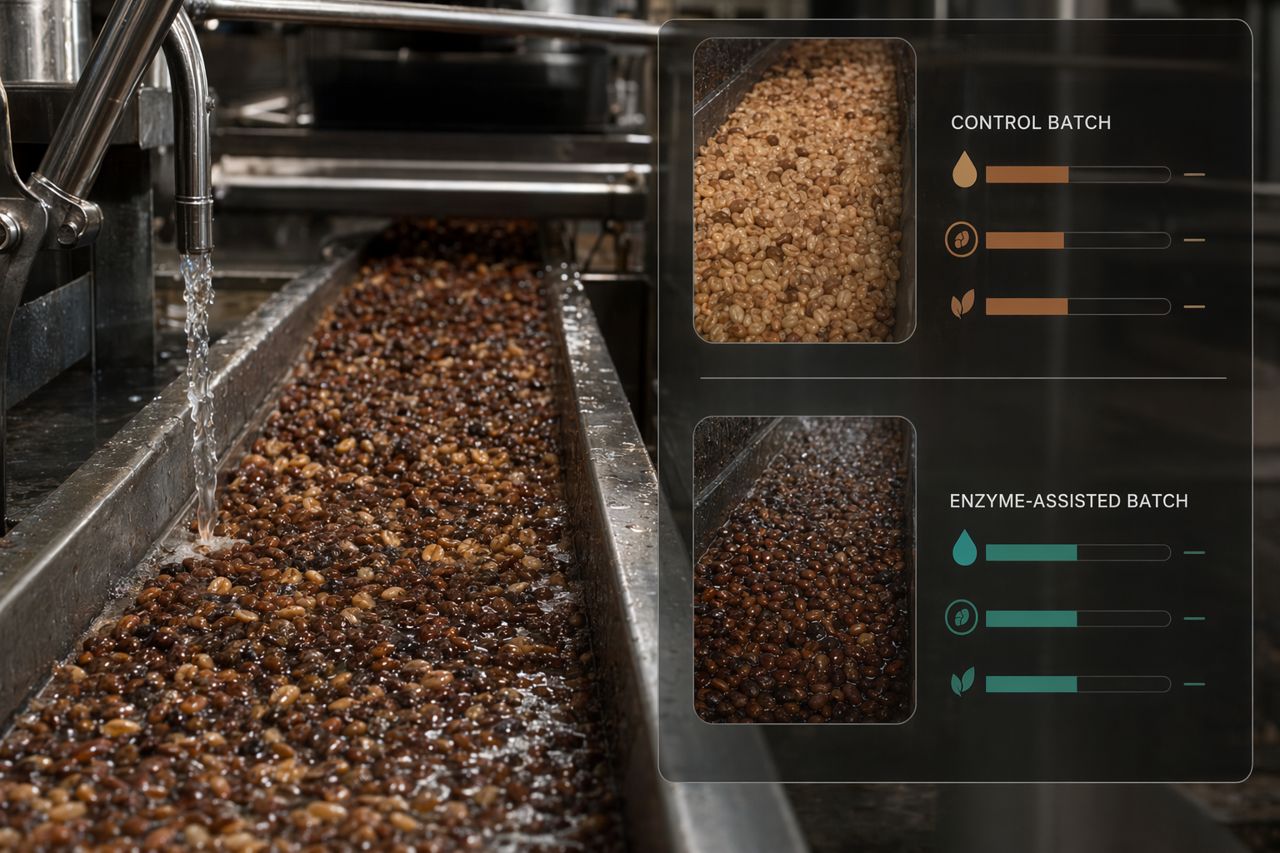
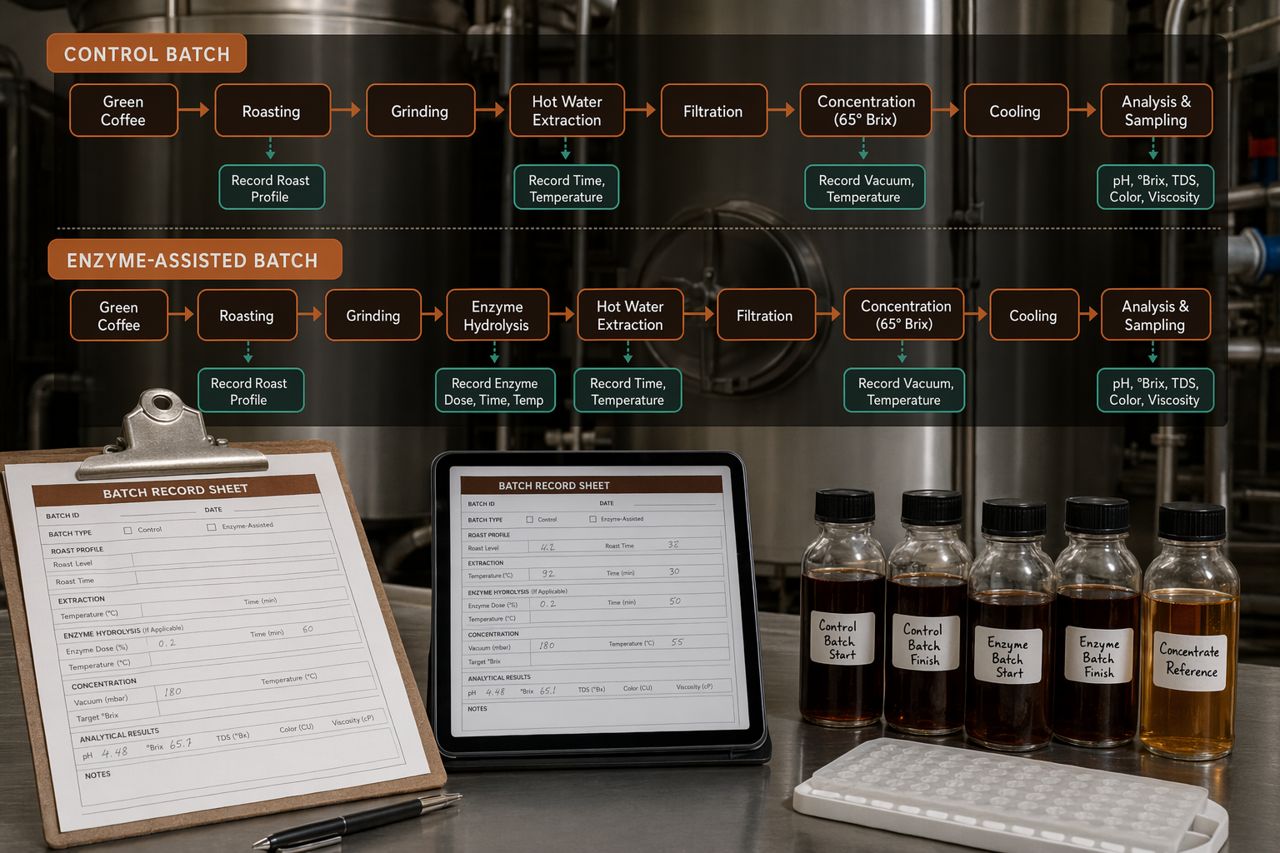
The basic format is simple: run a control batch under current plant conditions, then run one or more enzyme-assisted batches with documented changes only where intended.
Recommended trial structure
-
Define the process objective
Confirm whether the priority is mucilage handling, extraction yield, viscosity reduction, filterability, clarification, cycle time, or consistency. -
Select the workflow
Choose wet milling, coffee extraction, or a defined crossover point where upstream handling affects downstream performance. -
Protect the control
Use the same coffee lot or a matched lot, keep the same equipment path, and document normal operating settings. -
Set application points
Use low, mid, and high trial points recommended for the process objective. The trial should be wide enough to show direction, but controlled enough to avoid unnecessary disruption. -
Track plant-floor metrics
Focus on throughput, viscosity, filtration pressure, extraction yield, batch time, water demand, clarification behavior, and clean-in-place frequency. -
Review economics and operability
A technically improved batch must also make sense for production scheduling, labor, utilities, and downstream quality requirements.
Wet milling trial focus
For wet milling operations, enzyme-assisted processing is typically evaluated around mucilage release, parchment handling, water use, and batch consistency.
Practical measurements to capture
- Time to reach target mucilage removal condition
- Ease of washing and separation behavior
- Drainage quality and screen loading
- Water demand per batch or per production run
- Parchment handling through conveyors, tanks, and channels
- Batch-to-batch consistency under normal operator practice
- Downstream drying or holding impacts, where applicable
What a good wet milling result looks like
A successful wet milling trial should show operational control, not just faster breakdown. The best outcome is a cleaner, more predictable process window with fewer handling problems, steadier washing behavior, and less dependence on extended holding time.
Extraction workflow trial focus
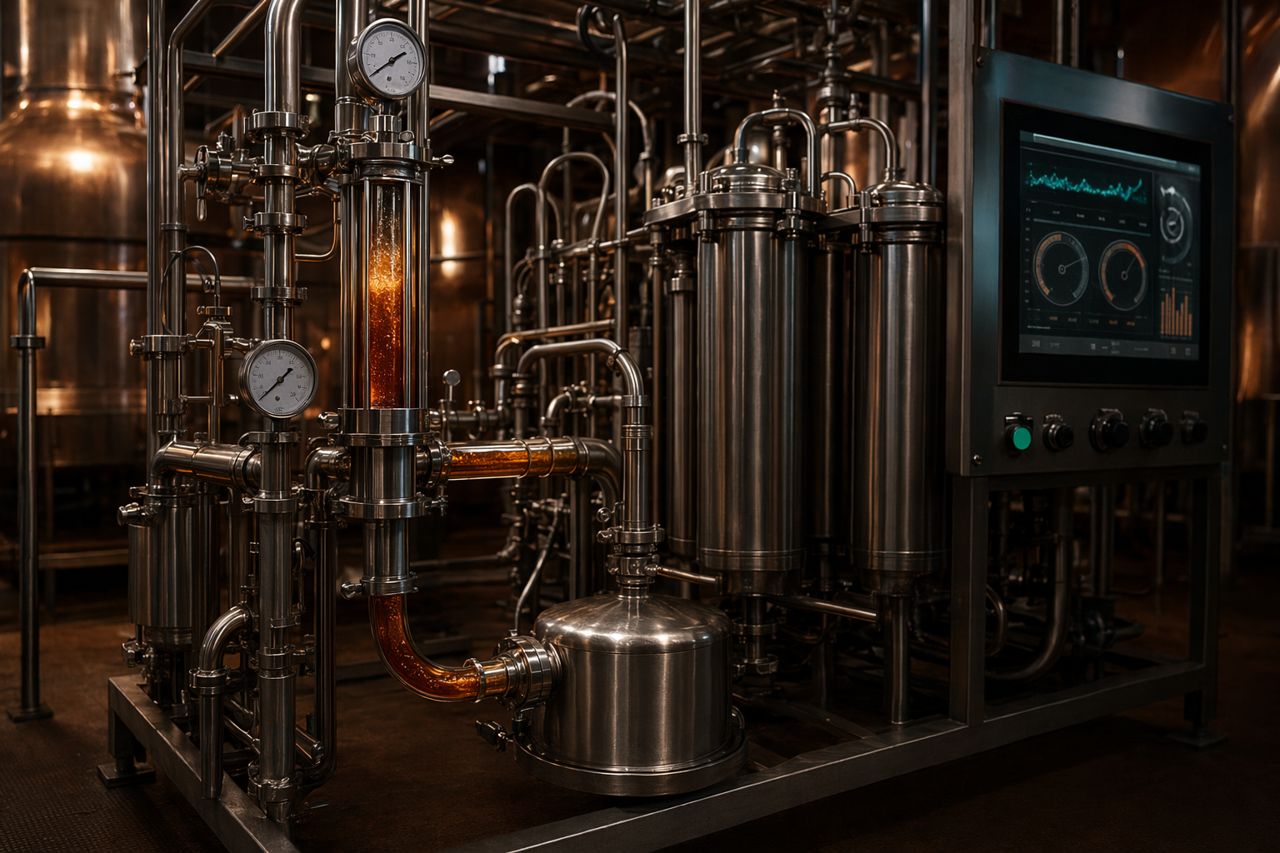
For extraction plants, enzyme-assisted processing is usually evaluated for viscosity reduction, soluble yield support, improved flow through filters, and more stable clarification.
Practical measurements to capture
- Extract viscosity at defined process points
- Soluble yield from the same coffee input
- Filtration pressure trend over the run
- Filter life or changeout frequency
- Clarification behavior and suspended solids handling
- Pumpability through transfer lines and heat exchangers
- Batch time, hold time, and clean-in-place frequency
- Finished extract consistency against internal quality targets
What a good extraction result looks like
A strong extraction trial does not only show more recoverable material. It should also support smoother handling: lower resistance through the line, fewer filtration bottlenecks, more predictable clarification, and reduced downtime around screens, filters, and cleaning cycles.
Variables your team should lock before the trial
To make the comparison usable, the following variables should be agreed before production starts:
- Coffee type, origin mix, roast or pre-treatment condition where relevant
- Grind or particle profile for extraction workflows
- Water quality and temperature window
- Batch size and fill level
- Residence time targets
- Agitation, circulation, or transfer conditions
- Filtration setup and condition at trial start
- Operator instructions and recording format
- Quality acceptance criteria for the output stream
The tighter the trial discipline, the easier it is to separate enzyme effect from ordinary plant variation.
Enzyme selection for coffee processing
Enzymeforcoffee recommends enzyme options based on the process objective and plant constraints. In coffee processing, enzyme programs may target pectin-rich structures, cellulose and hemicellulose contribution, viscosity drivers, or extract clarification behavior.
Selection depends on:
- Whether the process is wet milling, extraction, or downstream clarification
- The temperature and time window available in the plant
- The solids load and viscosity profile
- The filtration or separation equipment in use
- The tolerance for process change during validation
- The commercial value of yield, speed, water savings, or downtime reduction
The trial plan is designed to make selection evidence-based before full-scale supply is committed.
Trial records that support a scale-up decision
A useful decision file should include:
- Trial objective and success criteria
- Process map and application point
- Control batch records
- Enzyme-assisted batch records
- Operator observations
- Production metrics and quality checks
- Photos or video of process behavior where useful
- Cost-to-benefit estimate
- Scale-up recommendation and risk notes
This gives your plant team a practical basis for deciding whether to proceed, repeat, adjust, or reject the program.
Commercial evaluation: what changed and what it was worth
Enzymeforcoffee frames the trial around measurable operational value. Depending on your plant, the value case may come from:
- Higher extraction yield from the same coffee input
- Reduced viscosity and easier transfer
- Improved filtration rate or longer filter run time
- Shorter batch cycle or faster tank turnover
- Lower wash water demand in wet milling
- More consistent clarification
- Reduced clean-in-place frequency or duration
- Fewer unplanned slowdowns in the line
The final decision should connect process improvement to operating cost, capacity, product consistency, and risk reduction.
Validation support from Enzymeforcoffee
Enzymeforcoffee supports factory teams with trial planning, enzyme selection, application guidance, metric definition, and post-trial review. We work with your plant’s existing equipment and operating limits instead of forcing a laboratory-style process onto production.
Our role is to help your team answer four practical questions:
- Did the enzyme-assisted batch outperform the control?
- Was the improvement meaningful at plant scale?
- Did quality remain inside your specification?
- Is the process stable enough to justify a quote and supply plan?
Request a quote for a coffee enzyme trial plan
Use the on-site request form to tell us about your process, target improvement, and trial timeline. Include whether the trial is for wet milling, extraction, clarification, or a combined workflow.
A Enzymeforcoffee representative will review your process details and respond with a recommended enzyme trial approach, supply estimate, and next steps for plant validation.
Request a quote through the on-site form to start a controlled coffee enzyme trial plan.