Buying Processing Inputs for Coffee Factories: What Procurement Teams Should Standardize Before Peak Season
Peak season exposes weak procurement systems fast. A coffee processing plant can have sound equipment, trained operators, and a strong production plan, yet still lose throughput when processing inputs arrive late, arrive without the right documents, or behave differently from batch to batch.
For plants using enzymes to support extraction, viscosity reduction, filterability, mucilage or fiber management, and process consistency, procurement is not just buying a consumable. It is protecting production continuity.
As an enzyme supplier for coffee processing, Enzymeforcoffee works with factory teams that need inputs to fit real plant conditions: variable raw coffee quality, seasonal volume swings, tank scheduling pressure, filtration bottlenecks, and tight release timelines.
This article outlines what procurement teams should standardize before peak season, so purchasing, QA, technical, warehouse, and production are working from the same operating expectations.
Wholesale and bulk supply, quoted per order. For coffee processing plants, ingredient manufacturers and resellers buying enzymes ahead of the season. To get a quote, send the product or process step, the quantity you expect to use, and the destination country. Request a quote
1. Standardize the processing objective before standardizing the item
Before issuing purchase orders, define what the enzyme input is expected to improve. Vague buying language creates poor comparisons between suppliers and makes validation harder.
Procurement should align with production and technical teams on the target process role, such as:
- Reducing mash or extract viscosity for easier pumping and transfer
- Improving extraction efficiency from roasted or green coffee streams
- Supporting more consistent soluble solids recovery
- Improving filterability and reducing filter press or membrane load
- Helping manage plant fiber, parchment residues, or mucilage-linked handling issues
- Reducing process variability between lots of raw material
- Supporting shorter hold times where the process window allows
The purchase specification should connect the input to a plant-level outcome: throughput, yield, clarity, pressure stability, downtime reduction, or batch-to-batch consistency.
Procurement checkpoint
Do not qualify an enzyme product only by its label description. Qualify it by the process problem it is intended to control and the documentation needed to support that use.
2. Build a supplier qualification file before the production rush
Peak season is the wrong time to discover gaps in supplier documentation. A standardized qualification file reduces back-and-forth and prevents urgent purchasing decisions from bypassing QA.
For enzyme suppliers, request and maintain current versions of:
- Product specification sheet
- Safety data sheet
- Allergen, GMO, and regulatory position statements where applicable
- Country-of-origin and manufacturing site information where required by your system
- Food-grade suitability documentation
- Recommended storage and handling guidance
- Packaging format, pallet configuration, and minimum order details
- Shelf-life statement and lot coding format
- Change notification expectations
- Contact details for technical and supply escalation
Your internal approval process should define who reviews each document. Procurement owns supplier readiness, but QA and technical teams should approve documents before the first peak-season order is placed.
What good supplier qualification looks like
A qualified supplier should be able to answer practical plant questions without delay:
- What packaging sizes fit our dosing and storage setup?
- What is the recommended storage range and warehouse handling practice?
- How much lead time is required during seasonal demand?
- Can the supplier support validation at production scale?
- What information is provided for each lot shipment?
- How are supply interruptions or formulation changes communicated?
3. Define stock planning around production risk, not only average usage
Average monthly usage is not enough for coffee factories. Peak-season demand often arrives in uneven waves, and raw material quality can shift enzyme demand from one week to the next.
A stronger stock plan should include:
- Forecasted production volume by week or campaign
- Expected process application and dosage range approved internally
- Minimum safety stock based on lead time and production criticality
- Warehouse capacity and storage conditions
- Supplier production and dispatch lead time
- Import, customs, or inland transport buffer if applicable
- Planned shutdowns, holidays, or port congestion risk
- Maximum inventory age allowed by internal shelf-life policy
For critical applications, procurement should avoid planning only to the next delivery date. Instead, plan to the next verified delivery plus a risk buffer approved by finance and operations.
Practical reorder trigger
Set reorder points using a simple plant-floor formula:
Reorder point = expected consumption during supplier lead time + internal receiving time + safety stock.
Internal receiving time matters. If a product sits in quarantine for document review, sampling, or ERP release, it is not available to production.
4. Align storage requirements with warehouse reality
Enzyme inputs must be stored in conditions that preserve performance and keep QA comfortable with release decisions. Procurement should not approve a packaging format or order quantity without checking warehouse fit.
Standardize these details before the first large seasonal order:
- Storage temperature expectations
- Protection from direct sun, moisture, and contamination risk
- First-expiry, first-out inventory rotation
- Segregation from incompatible materials
- Clear lot identification in warehouse and production areas
- Handling instructions after opening
- Maximum time allowed for opened containers under site policy
This is especially important in coffee plants where heat, moisture, dust, and frequent movement of materials can challenge warehouse discipline.
Procurement checkpoint
If the supplier recommends a storage condition your site cannot consistently maintain, resolve it before approval. Do not rely on operators to compensate during peak production.
5. Standardize documentation per shipment
Every shipment should arrive with the documents your receiving and QA teams need. Missing paperwork creates invisible downtime: material is physically present, but not released.
For enzyme deliveries, define a shipment documentation checklist:
- Purchase order reference
- Product name and internal material code
- Lot or batch number
- Quantity and packaging count
- Certificate or quality statement as required by your QA system
- Safety documentation if updated
- Shelf-life or expiry information
- Transport condition notes where relevant
Procurement should also standardize naming conventions in the ERP. One product should not appear under multiple supplier names, abbreviations, or legacy codes. Clean master data reduces ordering mistakes and receiving delays.
6. Require technical validation support, not just commercial supply
Coffee processing conditions are not static. Bean origin, roast profile, particle size, slurry concentration, extraction temperature, residence time, and filtration equipment all influence how an enzyme solution performs.
A supplier should support validation in terms that matter to the factory:
- Trial plan structure
- Process window recommendations
- Compatibility with existing process steps
- Observable plant metrics to track
- Scale-up considerations
- Operator handling guidance
- Review of results against commercial objectives
The strongest validation plan connects enzyme use to measurable plant outcomes, such as:
- Faster transfer or reduced pumping strain
- Lower filtration pressure rise
- Improved clarified extract flow
- More consistent extraction yield
- Reduced tank hold time
- Fewer unplanned stoppages linked to viscosity or solids handling
Procurement should ask suppliers how they support validation before ordering peak-season volume.
7. Set reorder timing before urgent demand begins
Urgent reorders cost more than money. They create production anxiety, increase freight risk, and force teams into workarounds.
Before peak season, set three reorder controls:
Minimum stock level
The quantity below which procurement must act immediately.
Review frequency
A fixed weekly or twice-weekly inventory check during peak production, depending on consumption rate.
Escalation path
Named contacts at the supplier and inside the plant for urgent supply questions, documentation issues, or technical concerns.
A clear escalation path prevents the common peak-season problem where production, purchasing, warehouse, and QA all know material is running low, but no one owns the next action.
8. Compare suppliers on total plant value
The lowest line-item price is not always the lowest cost to the factory. Procurement should evaluate enzyme suppliers against operational risk and plant support.
A practical supplier scorecard may include:
- Consistency between supplied lots
- Documentation completeness
- Lead time reliability
- Packaging fit for plant handling
- Storage practicality
- Technical response speed
- Validation support
- Commercial flexibility for seasonal demand
- Ability to communicate changes early
- Performance against agreed plant metrics
When an input affects extraction, viscosity, filtration, or throughput, supplier reliability has a direct commercial effect.
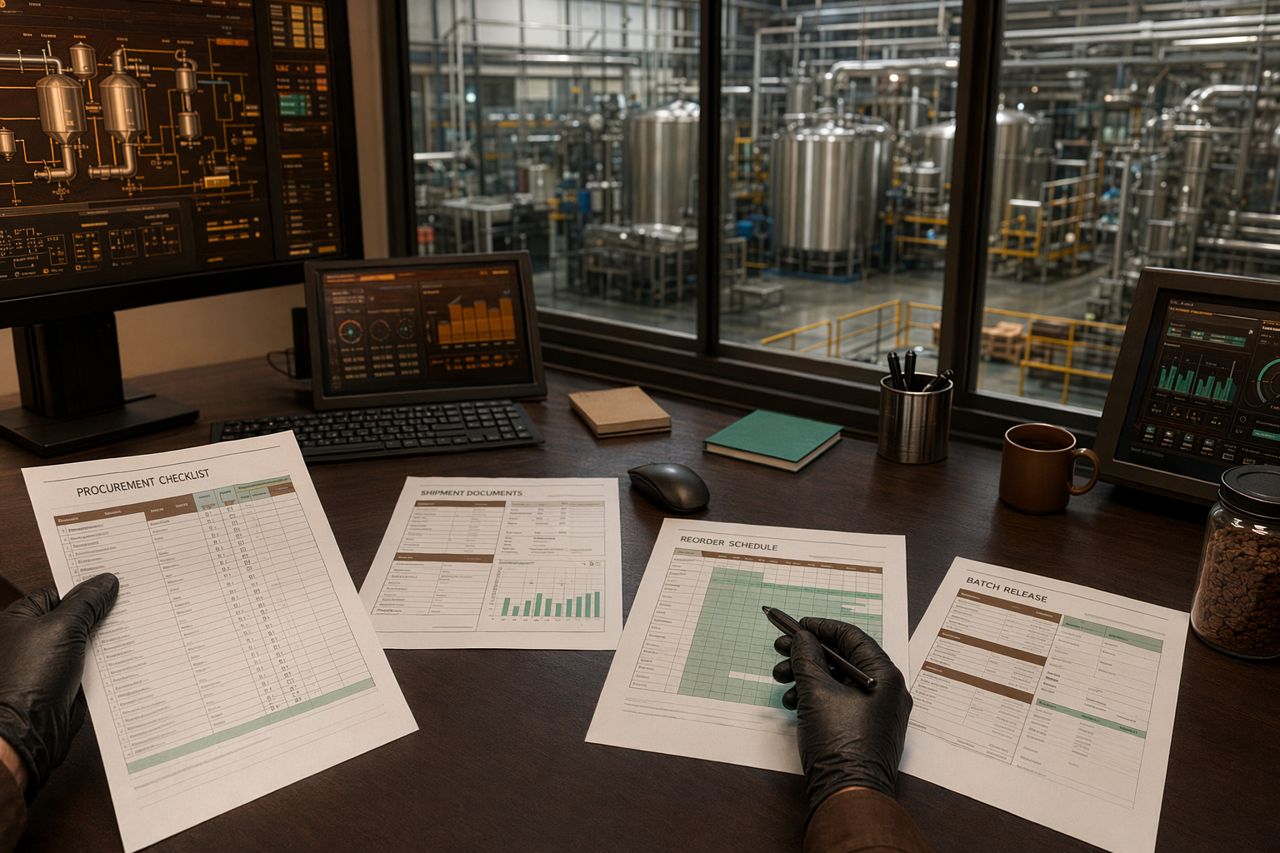
9. Create a pre-season procurement checklist
Use this checklist before seasonal production ramps up:
- Approved product specification on file
- Supplier qualification documents reviewed by QA
- Internal material code created and cleaned in ERP
- Storage requirements confirmed with warehouse
- Packaging format approved by production and EHS
- Reorder point calculated and loaded into planning
- Safety stock approved
- Shipment document checklist shared with supplier
- Technical validation plan completed or scheduled
- Escalation contacts confirmed
- Last order date before peak production agreed
- Internal stakeholders aligned on product use and process objective
This is not administrative overhead. It is production protection.
10. How Enzymeforcoffee supports procurement teams
Enzymeforcoffee supplies enzyme solutions for coffee processing plants where performance must translate into factory metrics: extraction yield, viscosity control, filtration stability, and predictable production flow.
We support procurement teams with:
- Clear product and shipment documentation
- Packaging and ordering guidance for plant use
- Storage and handling recommendations
- Seasonal demand planning discussion
- Technical support for plant validation
- Practical communication between purchasing, QA, and production teams
Our role is to help your team buy with less uncertainty and run with fewer avoidable interruptions.
Request a quote
If you are standardizing coffee processing inputs before peak season, use the inquiry form to share your process objective, the quantity you expect to need, the destination country, your expected production window, packaging needs, and documentation requirements. Enzymeforcoffee will respond with a supply and technical support path built for your plant.